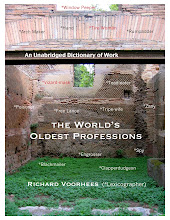
Someone who owns or works in a warehouse. A wholesale merchant.
"His richest warehouse is a greasie pocket,
And two pence in tobacco still does stocke it."
Samuel Rowlands, The Knave of Spades (1612).
Someone who owns or works in a warehouse. A wholesale merchant.
"His richest warehouse is a greasie pocket,
And two pence in tobacco still does stocke it."
Samuel Rowlands, The Knave of Spades (1612).
A scientist who studies insects.
“‘English entomologists care little or nothing for objects of practical importance,’ she exclaimed suddenly. ‘Take this question of flour infestation—I can’t say how many grey hairs that hasn’t grown me.’
‘Figuratively speaking, Miss Ormerod,’ said Dr. Lipscomb, for her hair was still raven black.
‘Well, I do believe all good work is done in concert,’ Miss Ormerod continued. ‘It is often a great comfort to me to think that.’
‘It’s beginning to rain,’ said Dr. Lipscomb. ‘How will your enemies like that, Miss Ormerod?’
‘Hot or cold, wet or dry, insects always flourish!’ cried Miss Ormerod, energetically sitting up in bed.”
Virginia Woolf, “The Lives of the Obscure,” The Common Reader (1925).
A boy who carried a torch, called a link, to light the way for people at night.
"So homewards and took up a boy that had a lanthorn, that was picking up of rags, and got him to light me home, and had great discourse with him, how he could get sometimes three or four bushells of rags in a day, and got 3d. a bushell for them, and many other discourses, what and how many ways there are for poor children to get their livings honestly. So home and to bed at 12 o'clock at night."
Samuel Pepys, Diary (March 25, 1661).
Someone who goes around looking for prey or plunder. A pilferer.
“At this moment I suddenly noticed that the audience was gazing in our directon with a good deal of interest, and I saw that the bearded chappie was pointing at us.
‘Yes, look at them! Drink them in!’ he was yelling, his voice rising above the perpetual-motion fellow’s and beating the missionary service all to nothing. ‘There you see two typical members of the class which has down-trodden the poor for centuries. Idlers! Non-producers! Look at the tall thin one with the face like a motor-mascot. Has he ever done an honest day’s work in his life? No! A prowler, a trifler, and a blood-sucker! And I bet he still owes his tailor for those trousers!’ He seemed to me to be verging on the personal, and I didn’t think a lot of it. Old Bittlesham, on the other hand, was pleased and amused. ‘A great gift of expression these fellows have,’ he chuckled. ‘Very trenchant.’
‘And the fat one!’ proceeded the chappie. ‘Don’t miss him. Do you know who that is? That’s Lord Bittlesham! One of the worst. What has he ever done except eat four square meals a day? His god is his belly, and he sacrifices burnt-offerings to it. If you opened that man now you would find enough lunch to support ten working-class families for a week.’ ‘You know, that’s rather well put,’ I said, but the old boy didn’t seem to see it. He had turned a brightish magenta and was bubbling like a kettle on the boil.”
P. G. Wodehouse, The Inimitable Jeeves (1923).
Someone hired to make public announcements. Someone who noted the sun's passage through noon and informed the Roman citizens that afternoon had begun. One who practices the art or science of blazoning armorial bearings and settling the right of persons to bear arms or certain bearings, in connexion with which it deals with the tracing and recording of pedigrees, and deciding of questions of precedence (OED).
"Nature soon covers the work of man in wood or stone with a carpet of moss and her own heraldry of lichens."
Century Magazine (1889).
Someone who looks closely as something, especially one employed to examine, count, or scrutinize votes in an election.
"The balloting began at eleven o'clock in the forenoon, and ended at six, when the scrutineers reported to the Directors."
The Gentleman's Magazine (1773).
In the military organization of the later Middle Ages, a squire is a young man of good birth attendant upon a knight. One ranking next to a knight under the feudal system of military service and tenure (OED).
"One day, then, when I would have joined Herr Neidhart and his troopers in their hostel, who indeed were mostly drunken, there among others I met this aforesaid Ape, and he was very heavy with drink and had much wind in his nose, and spake strange words. 'What brings this squireling hither?' quoth he; 'is he also to be one of us?' and suchlike scornful words, wherewith he thought to provoke me to wrath. This angered me, and I answered him 'What care I for thy scornful speeches and thy drunkenness? If we meet one day in the field, then we will see who of us twain is squire, and who is trooper.'"
Goetz von Berlichingen, Autobiography (1502).